





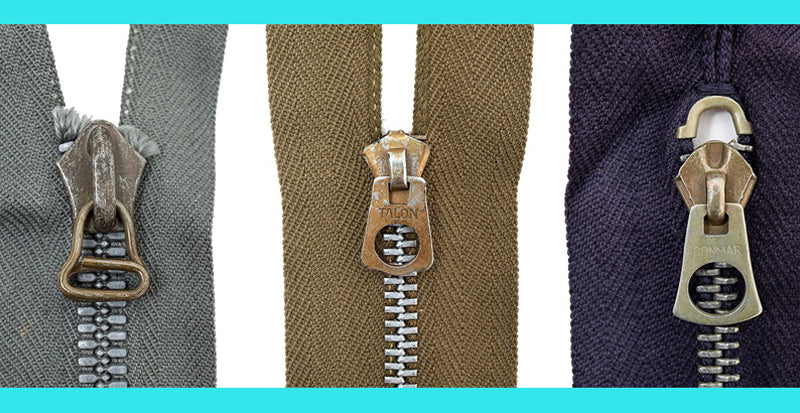
The History of the Zip
An early device known as an automatic continuous clothing closure, similar to the zipper was patented in 1851 by Elias Howe. It was a series of hook-like clasps with no slider, instead the two sides were joined together with string. Pulling the string meant the two sides were drawn together and the clasps interlocked.
Over the following 20 years improvements were made by inventors and engineers associated with a series of companies.
Initial versions were based on a system of hooks and eyes rather than interlocking teeth and tended to come apart easily. They relied on constant and even pressure from both sides of fabric. In 1891 there was a version which did have a type of slider but it was detached completely when not being used to open or close the zip.
Difficulties in getting machinery for mass production also prevented early devices from reaching the market.
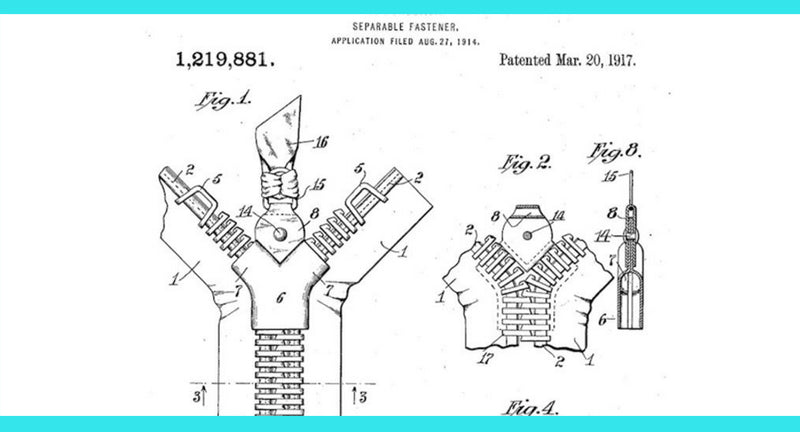
In 1906, Swedish-born Gideon Sundback joined the Automatic Hook and Eye Company in America and, through trial and error, in 1913 invented the first version of a zipper with interlocking teeth to prevent the pulling apart problem, called "Hookless Fastener No. 1." A year later, version 2 ironed out previous design faults and led the way to commercial success.

The principle is that each tooth has a dimple punched into the bottom and a conical nib on top. Each nib on one side engages with the dimple of the tooth opposite on the other side. They are brought together by the two 'Y' channels of the slider. The teeth, of course, are clamped onto thick fabric so that it can easily be sewn to a garment.
The first types were made of a low-friction, long-wearing brass alloy. The name zipper was used in 1923. They became popular for children's and men's clothing in the 1920s/30s. In the early 1930s, the designer Elsa Schiaparelli featured zippers in her avant-garde gowns, promoting them to become more popular in women's clothing.
In 1934, Tadao Yoshida founded a company in Tokyo, Japan, which later changed its name to YKK (Yoshida Kogyo Kabushikikaisha) and went on to become the world's largest manufacturer of zippers and other fasteners.
By World War II, zippers had become widely used in Europe and North America and after the war spread to the rest of the world.
Clergy in the '20s and '30s scorned the zipper for allowing clothes to be taken off more quickly, therefore encouraging illicit sexual activity. Clothing with zippers was not seen as appropriate for women's wear by some and was not fully adopted until the late 1950s. Can you believe it?
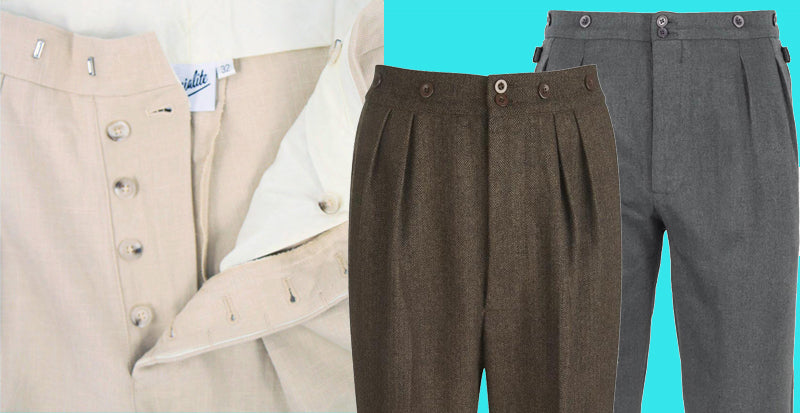
Some zipper style tips to help you date your clothes:
- Most men's pants continued to have button flies through the 1940s.
- Coil-type nylon zippers were invented in 1940 but not in common use until the 1960s.
- Side seam zippers were more common from the late 1930s to the 1960s.
- Short center back zippers and sleeve zippers are mostly late 1930s/40s.
- Center back zippers are seen occasionally on 1940s garments, but generally later in the 1950s/60s and nearly always from the 1970s on.


I had a used/vintage pair of denim (maternity?) pants with horizontal zippers, each consisting of a single row of teeth and a tab that pulled along the teeth and locked anywhere along the way. There were two zippers running along the waist band each from center opening to side seam, anchoring a center panel covering the opening. The pull-tab design looked something like the fletch of an arrow.
I cannot find any information or reference to this closure mechanism. Would you have any examples or information?